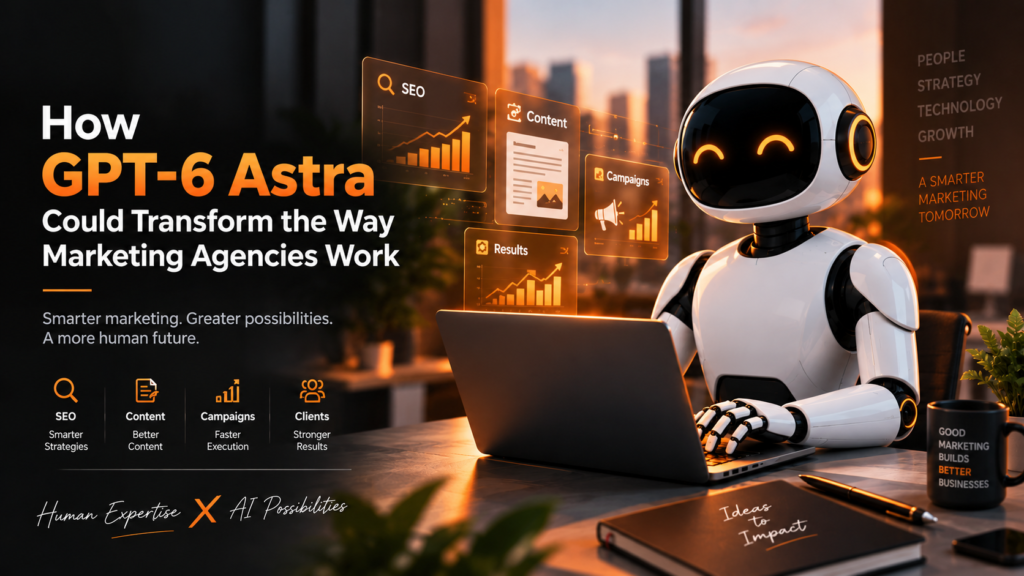
Artificial intelligence is no longer something businesses can afford to treat as a distant technological development. Over the last few years, AI has moved from experimental chatbots and basic content-generation tools into an increasingly important part of how companies research, communicate, analyse data and make business decisions. For the digital marketing industry in particular, this transformation is happening at an extraordinary pace.
The emergence of advanced AI systems such as GPT-6 Astra could take that transformation even further. Rather than simply helping marketers write an article, generate an advertisement or brainstorm keywords, increasingly capable AI can participate in complex, multi-step digital workflows. This has the potential to change not only how marketing work is performed, but also how agencies structure their teams, serve their clients and measure the value they provide.
For a digital marketing agency such as Ranking Xperts, this development presents an important opportunity. The question is not whether artificial intelligence will affect SEO and digital marketing. It already has. The more important question is how agencies can use increasingly capable AI to become more efficient and strategic without losing the human expertise that makes effective marketing possible.
From AI-Assisted Marketing to AI-Powered Marketing Operations
The first generation of marketing AI was primarily focused on assistance. A marketer could ask an AI tool to write a blog introduction, suggest social media captions, generate advertising ideas or provide a list of potential keywords. The human remained responsible for almost everything that happened before and after the AI generated its response.
GPT-6 Astra points towards a different model of interaction. With advanced reasoning, browsing and computer-use capabilities, AI can potentially become part of an entire workflow rather than remaining a tool used at one particular stage of that workflow.
This distinction is particularly important for marketing agencies because marketing rarely consists of isolated tasks. A successful SEO campaign, for example, starts with understanding a client’s business objectives and target audience. That understanding influences keyword research, which influences content strategy. Content strategy influences website architecture and editorial planning, while performance data subsequently influences what content should be created or optimised next.
In a traditional workflow, these activities may involve different people, different tools and considerable manual coordination. A more advanced AI environment could connect many of these activities together.
Imagine a client approaching Ranking Xperts with the objective of increasing qualified organic leads. Instead of simply asking an AI tool to produce a blog post, an AI-assisted workflow could begin by analysing the client’s website, understanding the existing content, researching competitors, examining search behaviour and identifying potential gaps. The resulting information could then support a content strategy, which could be reviewed by a human SEO specialist before being translated into content and optimisation tasks.
The human does not disappear from this process. Instead, the human moves further upstream, where strategic judgement matters most.
That may ultimately be one of the biggest changes AI brings to the marketing industry.
How GPT-6 Astra Could Change SEO
Search engine optimisation is one of the areas where advanced AI could have a particularly significant impact. SEO has always involved a combination of analytical work, technical knowledge, content development and strategic decision-making. Many of these activities are time-consuming, especially when an agency manages multiple websites at the same time.
Keyword research provides a useful example. An experienced SEO professional does not simply look for keywords with high search volume. They need to understand what people are actually trying to accomplish when they search, how competitive a query is, whether the search has commercial value and how the keyword fits into the broader topic structure of the website.
Advanced AI can help marketers process large amounts of this information more quickly. It can group related search queries, identify patterns, analyse search intent and help transform large keyword lists into meaningful topic clusters. This allows SEO professionals to spend less time manually organising information and more time deciding which opportunities are genuinely valuable for the business.
The same principle applies to competitor research. An SEO specialist may need to examine multiple competitor websites to understand what topics they cover, which pages attract visibility and where content gaps may exist. AI can accelerate this research process by helping organise and interpret information across many sources.
However, there is an important distinction between using AI to analyse SEO data and allowing AI to invent SEO data.
An effective agency should never treat an AI-generated search volume, ranking position or traffic figure as a substitute for actual evidence. Reliable SEO platforms, analytics systems and first-party business data remain essential. AI becomes most valuable when it helps marketers understand that information and turn it into practical decisions.
For Ranking Xperts, this creates an opportunity to combine the speed of AI with the experience of professional SEO specialists. The objective is not to automate SEO blindly. It is to make the SEO process faster, more informed and more scalable.
The Changing Role of Content Marketing
Content marketing is another area that is likely to undergo a major transformation.
For years, businesses have understood the value of publishing useful content to attract organic traffic, build authority and educate potential customers. However, creating genuinely valuable content at scale has always required substantial resources.
AI has already changed the first stage of this process. Writers and marketers can use AI to brainstorm ideas, develop outlines, research questions and create initial drafts. But the next stage of AI development could involve much more than generating text.
A sophisticated AI workflow could potentially help connect research, content planning, optimisation and performance analysis.
For example, suppose a business has a page targeting an important commercial search term but the page has gradually lost visibility. An AI system could assist with analysing the existing content, identifying changes in the search landscape, comparing competing pages and highlighting areas that may need improvement. A marketer could then use these insights to develop an updated content strategy.
This changes the role of content from a production exercise into a continuous optimisation process.
Instead of asking, “How many blogs should we publish this month?”, marketers can begin asking more valuable questions.
Which topics are attracting the right audience? Which pages are generating commercial intent? Which content is losing visibility? Where are users dropping out of the conversion journey? Which topics should the brand become known for?
These questions move content marketing closer to business strategy.
For Ranking Xperts, this means AI can become a productivity layer behind the content team while experienced marketers continue to control the editorial direction, brand voice, accuracy and overall purpose of the content.
Why More Content Does Not Automatically Mean Better SEO
One of the biggest risks associated with AI in digital marketing is the assumption that producing more content automatically creates better results.
It does not.
The internet already contains enormous amounts of content. Simply increasing the volume of pages published does not guarantee visibility, traffic or conversions. Search engines and users ultimately have to find the content useful.
This is why the future of AI-powered SEO will not simply belong to businesses capable of producing thousands of articles. It will belong to businesses capable of using AI to produce and improve content that genuinely satisfies users.
Human expertise becomes particularly important here.
A marketing professional understands the client’s customers, commercial objectives and brand positioning in ways that an AI system cannot always infer reliably. They can recognise when an article sounds generic, when a recommendation does not fit the business and when a piece of content technically targets a keyword but fails to answer the customer’s real question.
AI can accelerate production.
Experience determines whether the production is worth publishing.
GPT-6 Astra and the Rise of AI Search
The evolution of AI is also changing the search environment itself.
For many years, SEO was largely focused on achieving visibility in traditional search engine results. Businesses competed for rankings, clicks and organic traffic. Today, users are increasingly encountering AI-generated answers and conversational search experiences.
This creates a broader challenge for marketers.
A brand may need to think not only about whether its website appears in a conventional search result, but also about whether the information associated with that brand is clear, authoritative and useful enough to be understood by AI-powered search systems.
This is where concepts such as Generative Engine Optimisation, commonly referred to as GEO, are becoming increasingly relevant.
The fundamentals remain familiar. Brands still need high-quality information, strong topical authority, trustworthy sources and a technically sound online presence. But the way users discover that information is changing.
For a company such as Ranking Xperts, this creates an opportunity to help businesses prepare for a search environment in which traditional SEO and AI visibility increasingly overlap.
The goal should not be to chase every new AI trend. Instead, businesses should build strong digital foundations that make their expertise easy for both people and machines to understand.
From Campaign Creation to Campaign Execution
The impact of GPT-6 Astra could extend well beyond SEO.
Modern marketing campaigns involve a large number of connected activities. A campaign may require audience research, positioning, landing-page development, advertising copy, email marketing, social media content, creative direction, analytics and reporting.
Traditionally, these activities are distributed among specialists and managed through multiple platforms. This can create delays because every stage depends on another stage being completed first.
Advanced AI could reduce some of this friction.
An AI system could potentially take a campaign brief and assist with research, content development, asset preparation and workflow execution. Instead of using AI for one isolated task, an agency could incorporate it throughout the campaign lifecycle.
This could allow marketing teams to test more ideas, launch campaigns more quickly and spend more time evaluating what actually works.
However, speed should not become the only measure of success.
A campaign that launches quickly but targets the wrong audience is not a successful campaign. A perfectly written advertisement cannot compensate for an unclear value proposition. A sophisticated AI-generated campaign still needs human strategic direction.
The real advantage comes from combining automation with expertise.
How AI Could Change Client Reporting
Client reporting is another area where AI could have a meaningful impact on agency operations.
Marketing reports have traditionally focused heavily on numbers. Traffic increased, rankings changed, impressions grew, conversions declined and engagement moved in one direction or another.
But clients rarely need numbers without context.
A business owner wants to understand what those numbers mean for the business.
An advanced AI system can help transform large volumes of marketing data into a more understandable narrative. Instead of simply presenting a traffic increase, an agency can explain what caused it, which pages contributed to it, whether the traffic was commercially valuable and what should happen next.
This can make reporting more strategic.
For Ranking Xperts, the opportunity is to spend less time manually assembling repetitive reports and more time discussing the implications of those reports with clients.
That shift is important because clients do not ultimately hire an SEO agency to receive spreadsheets. They hire an agency because they want help growing their business.
The Economics of Running a Marketing Agency Could Change
Perhaps the most significant impact of advanced AI will not be technological at all. It will be economic.
Traditional agencies often sell time and resources. A client pays for a certain number of hours, deliverables or services each month.
But when AI makes certain tasks significantly faster, the value of an agency can no longer be measured simply by how long a task takes.
If an SEO specialist can complete in one hour what previously required five hours of manual research, charging based purely on those five hours becomes increasingly difficult to justify.
This pushes agencies towards a more outcome-focused model.
Instead of selling hours, agencies can increasingly sell expertise, strategy, systems and business results.
For Ranking Xperts, that could mean placing even greater emphasis on measurable outcomes such as organic visibility, qualified leads, conversion opportunities, content performance and sustainable search growth.
AI may make marketing production cheaper.
But it can simultaneously make strategic expertise more valuable.
Why Human Expertise Still Matters
It would be easy to interpret AI development as a threat to marketing professionals. However, a more useful perspective is to consider how the role of a marketer changes when repetitive work becomes easier to automate.
The value of a marketing strategist is not simply the ability to produce a paragraph of text.
It is the ability to understand why that paragraph should exist in the first place.
A marketer needs to understand the business, the audience, the competitive landscape and the commercial objective. They need to make decisions when the available information is incomplete. They need to understand brand reputation and recognise when an apparently attractive opportunity could actually damage the business.
These are areas where human judgement remains essential.
The most successful agencies are therefore unlikely to be those that simply automate everything.
They will be the agencies that understand which activities should be automated and which activities require human involvement.
Building an AI-Enabled Future at Ranking Xperts
For Ranking Xperts, adopting AI should not mean abandoning the principles that have always made professional digital marketing effective.
Instead, AI can become another layer within the agency’s operating model.
Research can become faster. Analysis can become deeper. Content production can become more efficient. Reporting can become more insightful. Repetitive administrative tasks can require less manual effort.
At the same time, SEO specialists can focus on strategy. Content experts can concentrate on originality and quality. Account managers can spend more time understanding client objectives. Strategists can focus on identifying opportunities that automated systems might overlook.
This creates a model in which technology handles more of the repetitive workload while people concentrate on the decisions that have the greatest business impact.
That is ultimately a more sustainable vision for AI in marketing.
The Future of Marketing Will Be Human and AI-Powered
GPT-6 Astra and similar AI systems are likely to change the expectations placed on digital marketing agencies.
Clients will increasingly expect faster execution, more personalised campaigns, deeper analysis and more frequent optimisation. Agencies that continue relying entirely on manual processes may struggle to compete with organisations that build intelligent automation into their operations.
But the answer is not to replace human marketers with machines.
The future is more likely to belong to organisations that combine the two effectively.
AI provides scale, speed and computational capability.
Human marketers provide context, creativity, judgement and accountability.
When those strengths are combined, the result can be more powerful than either one alone.
For Ranking Xperts, the opportunity is therefore much bigger than simply adopting another AI tool. It is about rethinking how digital marketing can be delivered in an environment where intelligent systems can assist with increasingly complex work.
The agencies that succeed in this environment will not necessarily be the ones that use the most AI.
They will be the ones that use it most intelligently.
As search continues to evolve, content becomes increasingly competitive and businesses demand measurable marketing outcomes, the combination of advanced technology and experienced human expertise could become one of the strongest competitive advantages an agency can build.
The future of digital marketing is not a choice between people and artificial intelligence.
It is about bringing the strengths of both together to create marketing that is faster, smarter, more relevant and ultimately more valuable to the businesses it serves.
Frequently Asked Questions
Can GPT-6 Astra replace a digital marketing agency?
GPT-6 Astra can potentially automate or accelerate many activities performed by digital marketing teams, but it does not eliminate the need for strategy, business understanding, creative judgement and accountability. The role of an agency is likely to evolve rather than disappear, with AI handling more operational work while specialists focus on strategy and outcomes.
How can GPT-6 Astra help with SEO?
GPT-6 Astra can assist with areas such as keyword research, search-intent analysis, competitor research, content planning and SEO workflow automation. Its greatest value comes when these capabilities are combined with reliable SEO data and human expertise.
Will AI-generated content replace SEO writers?
AI is likely to change the role of SEO writers, but high-quality content still requires editorial judgement, originality, expertise and an understanding of the audience. Rather than replacing writers completely, AI can help writers research, structure, draft and optimise content more efficiently.
What does GPT-6 Astra mean for marketing agencies?
For agencies, GPT-6 Astra could mean faster workflows, more scalable campaign management, improved reporting and greater automation of repetitive tasks. It could also encourage agencies to shift from selling hours and deliverables towards selling strategy and measurable business outcomes.
Should businesses use AI for their SEO strategy?
Businesses can benefit significantly from AI-assisted SEO, but AI should complement rather than replace professional SEO strategy. Reliable data, technical expertise, brand knowledge and human oversight remain important for sustainable results.
What is the future of SEO in an AI-powered search environment?
SEO is likely to expand beyond traditional rankings and clicks as users increasingly interact with AI-powered search experiences. Businesses will need to build strong topical authority, trustworthy information, technically sound websites and a recognisable online presence that can be understood by both search engines and AI systems.